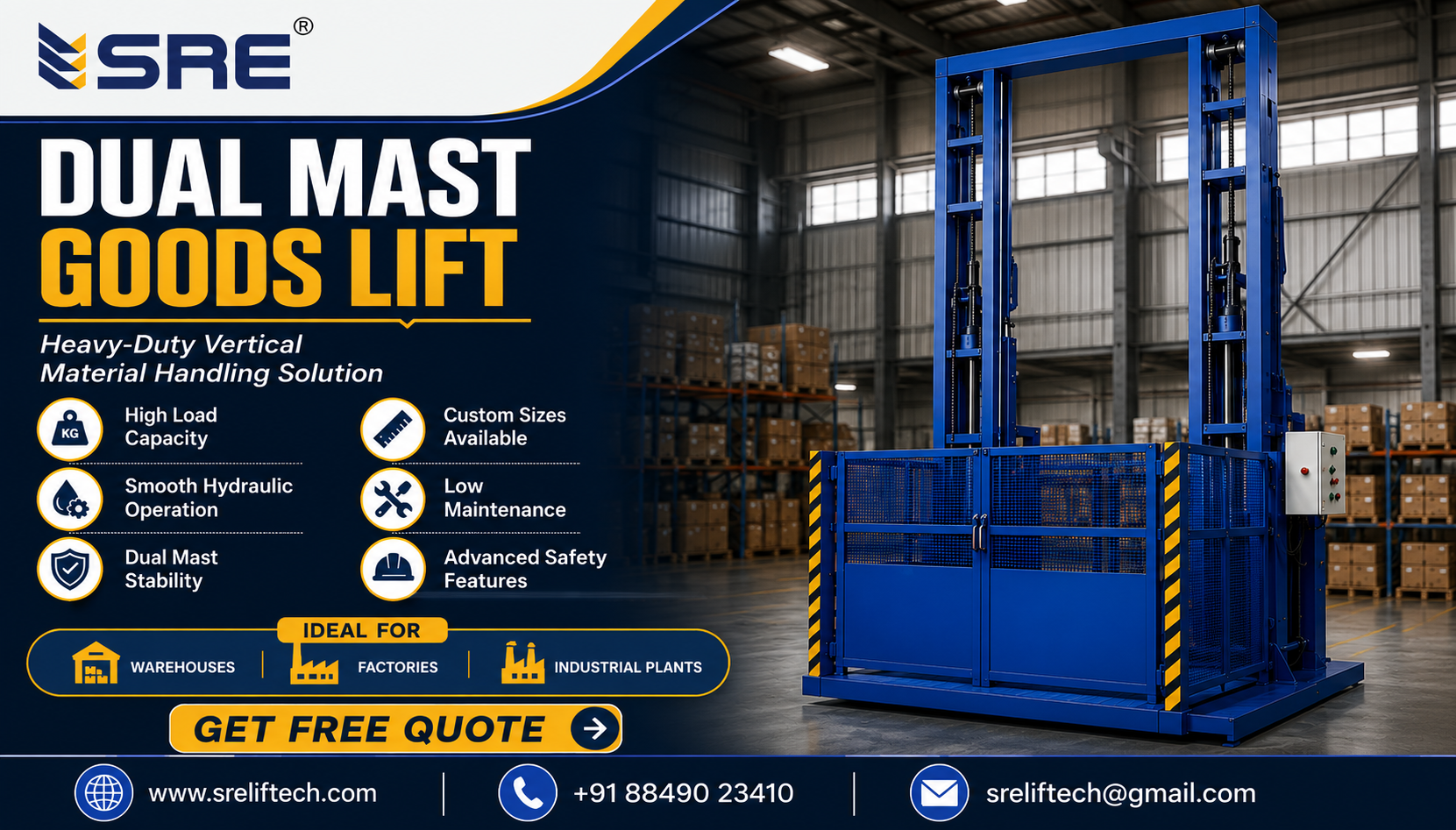
A Dual Mast Goods Lift improves material handling by increasing productivity, enhancing workplace safety, and reducing manual labor. Its stable dual-mast design supports heavy loads while ensuring smooth vertical movement in factories and warehouses. At SRE Lift Tech, we manufacture reliable, customized Dual Mast Goods Lift solutions that help businesses save time, lower operating costs, and improve workflow efficiency. Contact our experts today for the right lifting solution.
Every plant head knows the real cost of a slow, single-point material flow — it isn’t just the minutes lost, it’s the ripple effect on dispatch schedules, labour idle time, and eventually customer trust. Dual mast goods lifts solve a problem that single-column systems struggle with: stability under heavy, uneven, or off-centre loads across multiple floors. For Indian manufacturing units, warehouses, and multi-storey industrial facilities, this translates directly into fewer breakdowns, safer vertical transport, and a measurable jump in daily throughput. This article looks at how dual mast lift technology works, where it earns its keep on the shop floor, and what to check before you invest in one.

The best starting point for any equipment decision is understanding who is building the machine and how it’s tested. SRE LIFTTECH PVT LTD, based in Bakrol, Ahmedabad, designs, manufactures, and exports a full range of goods and scissor lifts — including Dual Mast Goods Lift, Single Mast Goods Lift, Hydraulic Goods Lift, and Pit-Less Hydraulic Goods Lift systems — under the leadership of Mr. Mayur Nagar.
Every unit is ISO 9001:2015 Certified and CE Compliant, with structural integrity tested at 125% of rated capacity before dispatch — not just at design stage. Capacities go up to 10 tons, and each lift is fitted with named safety systems: hose-burst protection valves, overload trip valves, door safety interlocks, mechanical limit switches, emergency stop buttons, and fallback prevention safety cables. These aren’t marketing terms; they’re the components an inspecting engineer will physically check during commissioning. As a goods lift manufacturer in Ahmedabad, SRE LIFTTECH also exports to mulitiple states and regularly delivers to Surat, Vadodara, Pune, and other industrial clusters.
Here’s how dual mast systems actually improve day-to-day operations. A single mast goods lift relies on one structural column, which works well for centred, moderate loads. A dual mast configuration uses two parallel masts, distributing load stress evenly and reducing lateral sway — critical when handling pallets, machinery parts, or drums that aren’t perfectly balanced.
SRE LIFTTECH’s manufacturing range covers this full spectrum: Standard Goods Lift, Dual Mast Goods Lift, Wall Mounted Goods Lift, and Pit-Less Hydraulic Goods Lift for sites where pit excavation isn’t feasible. On the scissor platform side, the lineup includes Pit Mounted Scissor Lift, Standard Scissor Lift, Movable Scissor Lift, Electrical Scissor Lift, and Customised Scissor Lift options built around a client’s floor height and load pattern.

Sectors that benefit most from dual mast lifts include warehousing and logistics (multi-level pallet movement), automotive and manufacturing (heavy component transfer), chemical and pharma (flameproof motor variants with stainless steel platforms), printing and paper stacking (auto-levelling sensors for stack alignment), and textile and garment units (lint-proof panel design). A Heavy Duty Goods Elevator built on dual mast architecture typically shows less mechanical fatigue over a 5-year cycle compared to single-column units running similar tonnage, simply because the load path is shared rather than concentrated.
Yes, we provide full certification documentation with every dual mast lift dispatched. ISO 9001:2015 governs the quality management process — from raw material inspection to final assembly checks — while CE compliance confirms the equipment meets European safety and design standards for lifting machinery. For a plant in Bangalore or Chennai exporting finished goods internationally, having CE-marked handling equipment on record can also matter during client or auditor visits.
Structural testing at 125% of rated load isn’t a regulatory minimum — it’s a buffer that accounts for real-world variables like uneven loading, occasional overloading by floor staff, or long-term wear. Combined with hose-burst protection and overload trip valves, this is what separates a Vertical Material Transport System built for continuous industrial duty from a lighter-duty platform meant for occasional use.
Plant heads in Mumbai, Delhi, Jaipur, and Indore often ask how a certified manufacturer compares against smaller local fabricators offering lower upfront quotes. Here’s a factual breakdown:
| Parameter | Typical Local Fabricator | SRE LIFTTECH |
|---|---|---|
| Certification | Often none or self-declared | ISO 9001:2015 + CE Compliant |
| Load Testing | Rarely documented | 125% rated capacity, documented |
| Safety Features | Basic limit switches only | Hose-burst protection, overload trip valves, door interlocks, fallback safety cables |
| Max Capacity Range | Varies, often unverified | Up to 10 tons, verified |
| Export Documentation | Limited | Export-ready |
| Customisation | Limited configurations | Flameproof, stainless steel, auto-levelling, lint-proof variants |
This isn’t to say local fabricators can’t do decent work — for light-duty, occasional-use applications, they’re sometimes a reasonable fit. But for continuous multi-shift operations, the documentation and testing gap tends to show up as downtime within the first year or two.
This process applies whether the client is in Hyderabad setting up a new cold-chain warehouse or a Kolkata-based printing unit needing auto-levelling stack handling.
A mid-sized logistics operator running a three-storey warehouse near Ahmedabad had been using a single mast lift for pallet transfer between floors. Frequent lateral sway during loading — especially with off-centre pallets — was causing both delays and operator hesitation near the platform edge. After switching to a Dual Mast Goods Lift rated for 5 tons, the client reported noticeably steadier platform movement during peak dispatch hours, and floor supervisors mentioned that loading confidence among staff improved once the sway issue was resolved. This is a fairly typical pattern we’ve observed across similar multi-level facilities — the structural difference between one mast and two isn’t cosmetic, it directly affects how comfortably staff can work around the equipment daily.

Similar upgrades have supported operations for clients across Pune, Chandigarh, and Surat, particularly in sectors handling irregular load shapes.
For a free equipment consultation, a copy of the Industrial Lift Cost Guide, or direct enquiries, call +91 88490 23410, or reach the team on WhatsApp at +91 75748 85758. You can also write to sreliftech@gmail.com or visit SRE LIFTTECH at Plot No:13, Shreenathji Industrial Estate Part-2, Bakrol Bujrang Road, Bakrol, Ahmedabad, Gujarat – 382430. If you’re comparing an industrial goods lift supplier for an upcoming facility upgrade, a documented site assessment is the most reliable starting point before finalizing specifications.
Consult our service engineers today for priority quotes and CAD specification details.